

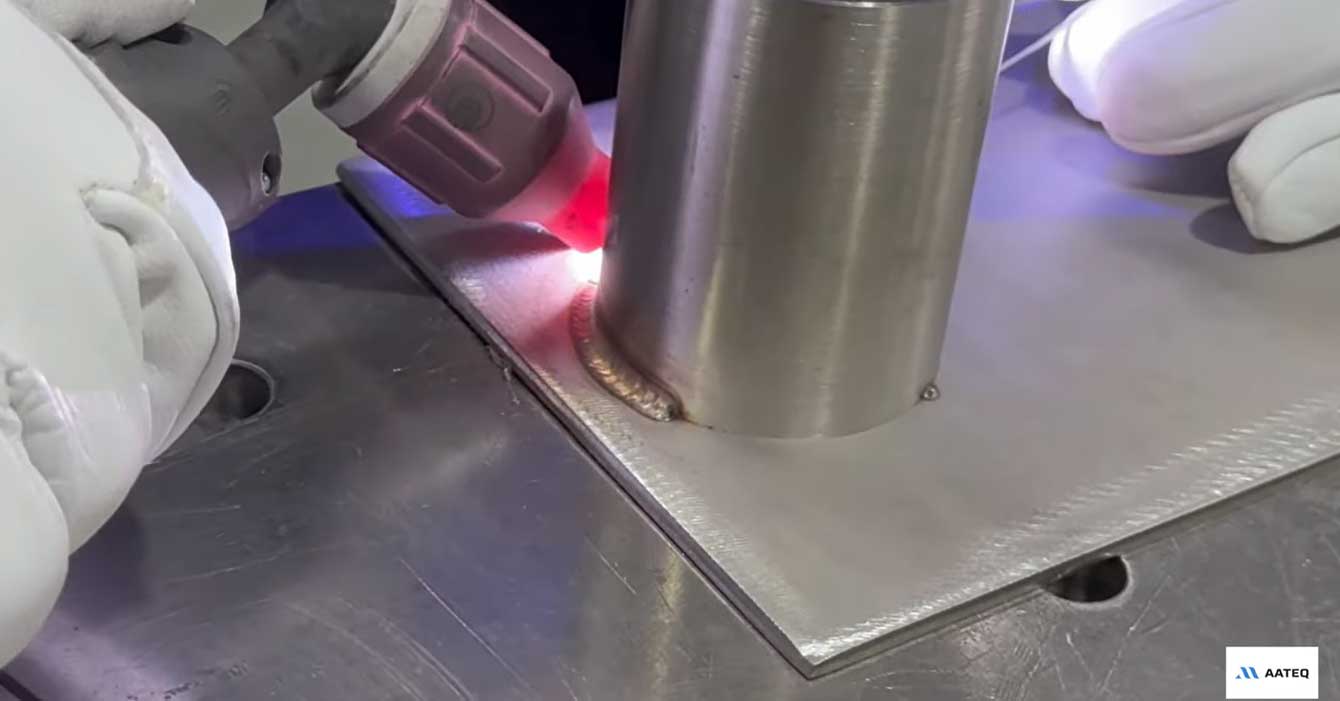
At AATEQ, we constantly invest in expanding our production capabilities to meet the demands of industrial projects that require precision, reliability, and quality in execution.
We recently opened a new department dedicated to the machining and welding of stainless steel, designed to serve projects in both the food and packaging industries. Within this department, we manufacture parts, metal structures, and assemblies according to each client’s technical drawings and specifications.
By integrating welding operations with mechanical machining processes, such as CNC milling and turning, we offer manufacturing capabilities for industrial components and subassemblies. This approach allows us to coordinate production stages and ensure compliance with technical requirements throughout the entire manufacturing process.
What is TIG welding, and what are its advantages?
TIG (Tungsten Inert Gas) welding is an electric arc welding process that uses a non-consumable tungsten electrode and an inert gas to shield the welding zone. Thanks to precise control over the electric arc and the molten metal pool, the process enables the creation of high-quality joints and is frequently used for stainless steel and other materials that require careful control of the welding process.
The quality of the joint influences the mechanical strength, in-service behavior, and durability of the components. Therefore, selecting the appropriate process, preparing the surfaces, and correctly adjusting the welding parameters are essential for achieving consistent results.
Among the main advantages of TIG welding are:
- Precise control of heat input—allows the process to be adapted to the material thickness and joint geometry, helping to minimize distortion.
- Joint quality—facilitates the production of uniform weld beads with a high degree of control over geometry and appearance.
- Aesthetic finish—enables the creation of clean-looking joints, which are important for components with visible surfaces.
- Adaptability to complex applications is suitable even for thin sheets, precision components, and hard-to-reach areas, depending on the job configuration.
To achieve the required level of quality, the process must be tailored to each application. Material preparation, the choice of filler material, inert gas shielding, and control of welding parameters all contribute to achieving reliable joints.
The Role of TIG Welding in the Food Industry
In the food industry, metal equipment and structures must meet specific requirements regarding hygiene, cleanability, and corrosion resistance. For this reason, joint execution and surface finishing play an important role in the manufacture of components used in this sector.
TIG welding produces uniform and controlled weld beads, suitable for numerous applications where surface quality and precision of execution are essential.
For stainless steel components intended for environments with strict hygiene requirements, the result depends on both the quality of the weld and the joint design, weld bead continuity, and surface finish. Depending on the application, additional operations may be necessary to remove oxides and restore surface properties after welding.
By applying appropriate procedures and carefully controlling the manufacturing process, we can produce components designed to meet the technical requirements and operating conditions specific to the food industry.
AATEQ – Integrated Welding and Machining Capabilities
The development of the new stainless steel department represents an important step in expanding AATEQ’s production capabilities and diversifying the industrial projects we can undertake.
We combine our expertise in metalworking with CNC welding, milling, and turning operations to produce parts and assemblies tailored to the requirements of each project. We work based on technical drawings and specifications provided by customers, ensuring dimensional accuracy, high-quality workmanship, and the proper integration of components into the final assembly.
Through investments in infrastructure and the development of technical expertise, we are strengthening our ability to handle projects that require manufacturing flexibility and attention to detail.
Do you have a project that requires stainless steel components or assemblies?
Contact us to discuss your technical requirements and manufacturing options. We are ready to analyze your project and identify a solution tailored to your industrial application.